Avijit had a peculiar habit. He lived in the present, earned in the present, paid his EMIs in the present. But mentally, he spent a good part of his day somewhere in the 1980s.
“Papa,” his daughter Anaya said one morning, “did Wi-Fi exist in your golden childhood?”
Avijit looked up from the newspaper, adjusting his glasses with mock seriousness.
“No. We had something better.”
“Oh God,” his son Aarav groaned, “here it comes.”
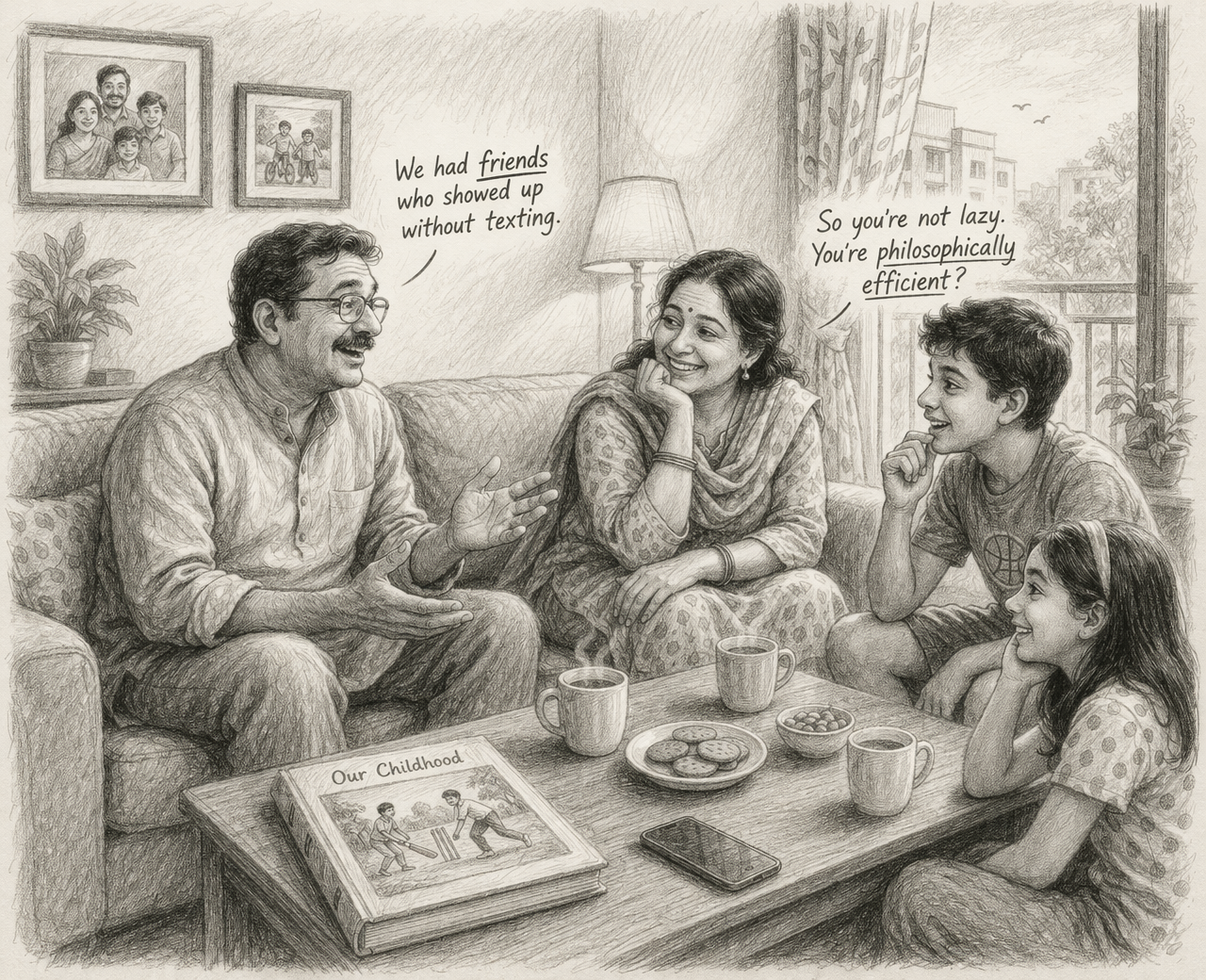
“We had friends who showed up without texting,” Avijit said triumphantly.
Jyoti, his wife, walked in from the kitchen, wiping her hands. “And also, electricity cuts, muddy streets, and no Swiggy. Don’t forget those.”
Avijit smiled. “And yet, we never felt enraged at the electricity cuts. We enjoyed that excuse to not study and have fun in those same muddy streets. And the less you talk about ordering food, the better. If you didn’t like the tinde ki subzi your Mom made, you could just walk over to the neighbour’s house and join them at their dinner.”
The family burst out laughing.
This was routine.
Avijit, a well-settled professional in his early forties, had everything one could reasonably ask for – a stable job, a warm home, two bright children, and a wife who understood him better than he understood himself. Yet, he carried with him a quiet, persistent affection for his childhood.
And he visited it often. Too often, according to his family.
“Papa,” Aarav said one Sunday morning, “can you please fix the leaking tap?”
Avijit leaned back on the sofa. “You know, when I was your age, we had no piped water. We used to bathe with a bucket and mug. No taps, no complaints.”
“Exactly,” Aarav shot back. “So, you fix the tap now. Progress, Papa. Progress.”
Jyoti added, “Or at least call the plumber. Don’t philosophise the pipe.”
Anaya chimed in, “Papa just wants to emotionally connect with the bucket and the mug.”
Even Avijit laughed at that.
But later that evening, the teasing continued over the evening coffee.
“Papa would have been very happy in his childhood,” Anaya declared. “No responsibilities. No bills. Just nostalgia.”
“Correction,” Aarav added, “Papa still lives there. We are just guests in his present.”
Jyoti smiled, but this time she looked at Avijit carefully.
“Tell me something,” she said gently, “why do you go back there so often?”
Avijit didn’t respond immediately.
For once, he wasn’t smiling.
He placed his cup aside, leaned back, and looked at all three of them – his world, sitting right in front of him.
“You really think I go there to escape this?” he asked quietly.
The room softened.
“Well… a little?” Anaya said cautiously.
Avijit shook his head.
“No,” he said. “I go there so I can handle this better.”
They looked at him, puzzled.
He continued, now slowly, like someone choosing his words with care.
“When I think of my childhood, I don’t remember the things we didn’t have. I remember how little we needed to be happy.”
He smiled faintly.
“We didn’t compare. We didn’t compete. We didn’t worry about what others were doing. If someone had a new cricket bat, we didn’t feel jealous. We just asked if we could play one over.”
Aarav smiled at that.
“If we lost a match,” Avijit went on, “we forgot it in ten minutes. If we fought, we made up before sunset. The next morning had to be normal again. No ego. No baggage.”
Jyoti watched him quietly.
“Now look at us,” he said. “So many things, so many comfort. But also, so many thoughts. Too many comparisons. Too many expectations.”
He leaned forward slightly.
“I don’t go back to my childhood because life was easier,” he said. “I go back because I was simpler.”
That landed.
“And when I remind myself of that boy,” he continued, “I remember how to deal with things today.”
“How?” Anaya asked softly.
“Like a child would,” he said. “Do what needs to be done, without overthinking. Don’t carry yesterday into today. And don’t measure your happiness against someone else’s.”
“I deal with my current day problems, thinking how I used to settle mine as a child.”
He smiled again, lighter now.
“If you keep that child alive inside you,” he said, “you don’t ever get lost. No matter how complicated life becomes.”
There was silence for a moment.
Then Aarav said, “So basically… you’re saying you’re not lazy. You’re philosophically efficient?”
Avijit grinned. “Exactly.”
Jyoti shook her head, smiling. “Nice try. The tap still needs fixing.”
Anaya added, “And the ‘inner child’ can start with calling the plumber.”
Avijit stood up, picking up his phone.
“Done,” he said. “But after that, we are playing cricket. One tappa out, if you know what that means.”
“Oh, no. Another childhood mantra! In the society compound?” Aarav asked.
“Yes,” Avijit said. “No scorekeeping. No arguments. The youngest bats first.”
“And if we fight?” Anaya teased.
“We make up before dinner,” he replied.
Jyoti watched them step out together. Her grown-up husband and the two children who were about to discover a slightly older version of themselves.
She smiled.
Some people grow up and leave their childhood behind.
And some, like Avijit, carry it gently. Not as an escape, but as a compass.
 The sound of thought