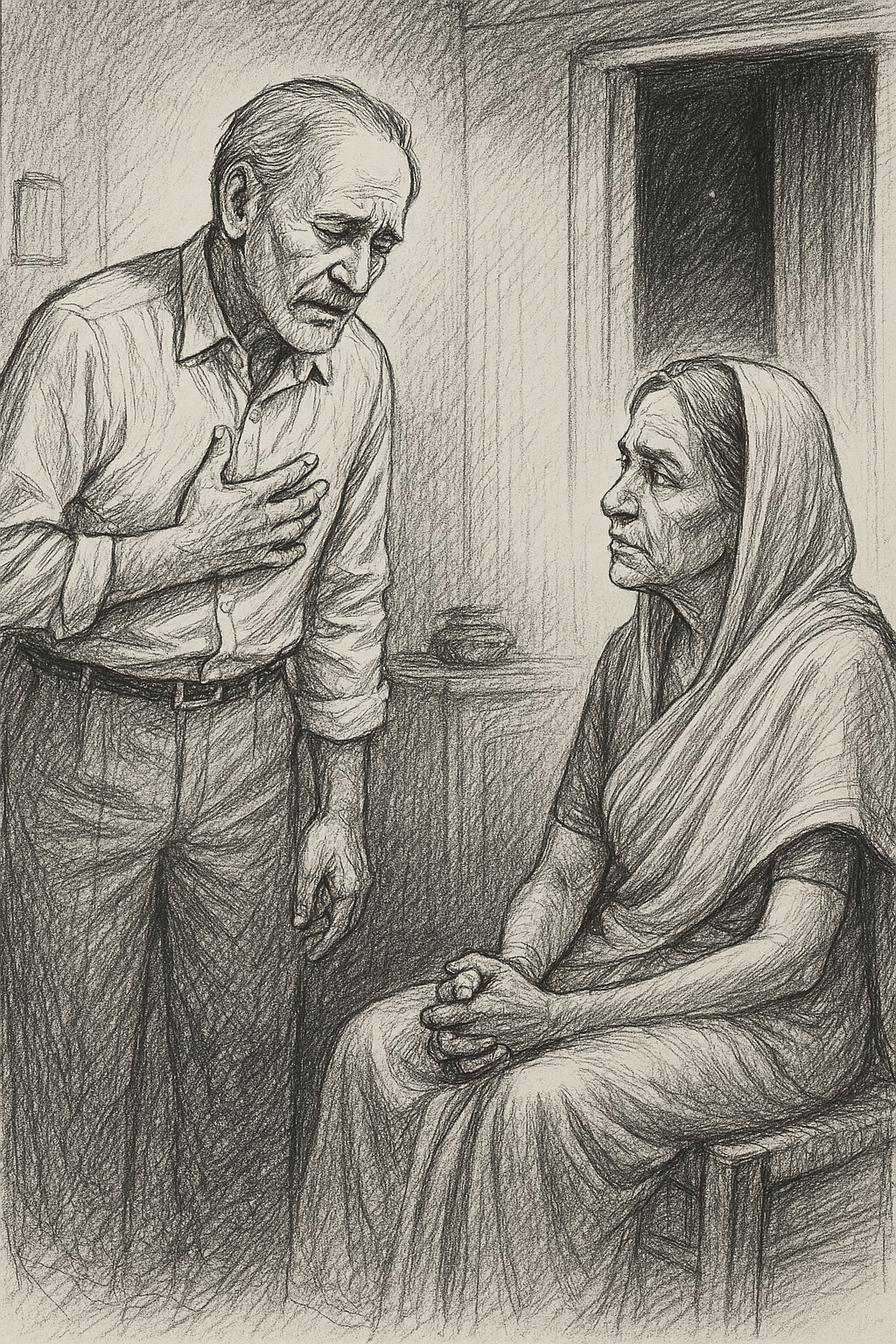
It was dusk when Rajeev Kumar stood in front of the rusting gate, hesitating like a man caught between two times. The narrow alley behind him stretched like a forgotten memory, and the modest house before him looked weary, as if carrying years of quiet battles.
He knocked on the door. He heard a creaking chair followed by the footsteps and the door opened with a groan.
Anita stood there, framed by the dim yellow light behind her. The years had not been kind — her once luminous skin was now etched with tired lines, her eyes hollowed by time and hardship. But there was something defiant in her gaze, a spark untouched by all the tribulations suffered.
She stared at him for a long second, without saying anything. He had hoped to see fury, hatred towards him on her face. But there was nothing.
“Rajeev,” she said at last, flatly. Not a question. Not a greeting.
“I… need to speak with you,” he said. “Please.”
She turned without a word. He stepped in, heart pounding like a guilty drum. The living room was sparse, but clean. The only chair in the room was jaded and sagging. On a small kitchen platform in the corner of the room, something was cooking on a stove.
She motioned to the chair and sat across from him on a tiny stool, arms folded, her body angled away just enough to signal that grace had limits.
“Say what you came to say,” she said.
He opened his mouth, and for a moment, nothing came. The words that had plagued him for months dissolved like mist.
He shifted in his chair, wiped his palms against his trousers, opened his mouth — and stopped. Tried again. The words gathered at the edge of his tongue like a dammed river. “Do you ever wonder if the past finally wakes us up when it is very inappropriate?” he said finally, eyes not meeting hers.
Anita said nothing.
He murmured, as if speaking to himself, “I thought I had buried it deep. So deep, that it would never find its way to the surface. But lately, it digs back through my dreams. And I see you. Not the courtroom, not the boardroom. Just you. Pale and tired, hoping against hope for justice. Eyes full of storm, yet dry of tears.”
He took a deep breath, then looked her straight in the eye.
“You were right. I did it.”
The silence was not silence, not really. It was the roar of twenty-five years collapsing between them.
Her face did not change.
He drew a deep breath, the kind that precedes either collapse or confession. “You knew it, even then,” he said, voice cracking. “And yet… I needed to say it aloud. To you. Not the world. Just you.”
“We were arguing about the merger. He found out I was forging the documents and was about to expose me. No other thought came to me, except that he has to be eliminated.”
He continued his monologue after a brief pause, “I was never into doing the business righteously because I wanted money, and a lot of it. His morality would have never allowed that. I even justified my actions to myself, as money started flowing in. I would have lived miserly with his saintly scruples and principles.”
Anita stared at him. Not blinking.
Inside her, a silence stirred. Not of calm, but of memories long chained. She remembered nights without sleep, counting coins, measuring rice. She remembered the courthouse — the indifference of law, the weight of being disbelieved. Her heart wasn’t racing. And in that cold clarity, she realized something — he had finally arrived at the threshold she had crossed decades ago.
He leaned forward, suddenly desperate.
“Six months ago, I saw you,” he said. “By chance. Outside a clinic. You were thinner, older — but it was you. And in that instant, the past came alive like a fire lit under dry leaves. I couldn’t breathe. I couldn’t look away. I had no courage to face you, to talk to you then. But you never left my mind.”
He paused. His voice softened, almost ashamed.
“For twenty-five years, I lived untouched. Slept soundly, laughed at parties, gave to temples. I believed the past was a stone sunk too deep to rise again. But just the last six months since I saw you — six months of guilt — have torn through me like twenty-five winters. I am not even half as strong as you were.”
“Anita, I can’t sleep. I can’t eat. I see him in mirrors, hear his voice when I close my eyes. I thought I could outrun it with charity, with wealth. But nothing helps. I came to ask — no, to beg — for your forgiveness. Tell me what punishment you see fit. Jail, ruin, shame. Anything. I just want peace.”
Her voice, when it came, was calm. Too calm.
“You want peace.”
He nodded. Swallowed.
She stood up, walked to the window. Outside, the moon was rising.
“And what do you think I have had for twenty-five years?”
He said nothing.
“I lost a husband. A life-partner. I lost my house, my name, my bearings. I lived in places where landlords knocked at midnight. I have eaten dry roti with water. I have begged, Rajeev. Not for money. For work. For dignity. I have aged, not by years, but by the weight of each day that passed without justice.”
She turned back to him.
“And you want forgiveness?”
Although her voice was sharp and clear, there was no sarcasm. She wasn’t mocking him.
“You see,” she said softly, “we both are destined to serve a sentence. Yours is beginning. Mine is ending.”
He looked down. Which was good, as it helped him hide the fear written all over his face. Her words had hit him like a thunder.
With some courage, he broke the silence. “Then let me do something. Anything. Give me the burden. Let me pay.”
She sat down again, slowly. She looked composed like a monk at an altar.
“You can pay,” she said, “by carrying the guilt. Not for a year. Not until your blood pressure stabilizes. For as long as you breathe. This guilt is your inheritance. Your equity. You sought justice? Here it is. No court can sentence you as thoroughly as your own conscience. I am sorry Rajeev, but it is beyond me to offer you a consolation. The consequences of some of our actions are beyond the human realm. We can only live through them.”
He looked up, broken.
She rose and walked toward the door, signaling the end of the conversation.
“Go back to your mansion, Rajeev. To your reputation, your charities. But know this — no one escapes their crime. You thought you were free, but you were not untouched. Your suffering has only begun. And unlike you, I find no pleasure in that. Only balance.”
He rose, knees trembling. As he stepped out into the night, he felt smaller than he had ever felt in his life.
Behind him, Anita closed the door gently. The burden of this encounter had drained her of all her energy. She sunk into the chair, recollecting what had just happened.
Then she smiled. Not with malice. But with the calm exhale of a wound that had finally stopped bleeding. “Some debts,” she crooned, eyes fixed on the stars outside her tiny window, “are written in silence—and must be paid for in sleepless nights.”
 The sound of thought