The COP27 in November 2022 was a failure in making progress on its core objective – limiting the global warming to 1.50 C – the famous net zero phenomenon, a target that was hailed a big breakthrough in Paris seven years ago. The disagreements on who should play the leading part in meeting this target continue and as such, this target looks as bleak as ever. What was achieved was the pledge to setup a loss and damage fund that will provide aid to the developing countries at the receiving end of the climate change, but the sources of such a fund have been left ambiguous, as are the beneficiaries. Another failure was to endorse the push by India to phase out all fossil fuels, as against only coal agreed in COP26.
The Global Risk Report 2023 by World Economic Forum (WEF) has published a list of global risks by severity. While a short-term (2-year) outlook of such risks are dominated by the cost-of-living crisis and the geopolitical / geoeconomical confrontation by the ongoing war, the long-term (10-year) forecast is all dominated by environmental factors. The top four are as under:
1. Failure to mitigate climate change
2. Failure of climate-change adaption
3. Natural disasters and extreme weather events
4. Biodiversity loss and ecosystem collapse
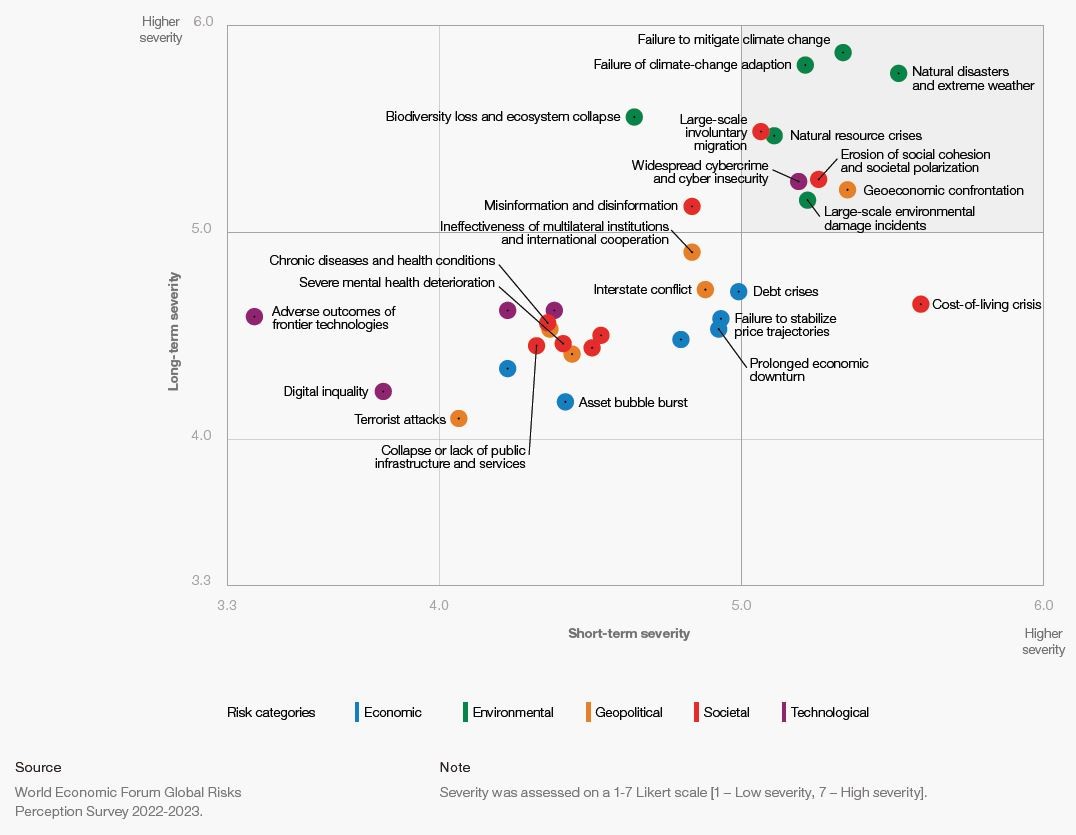
The relative severity of risks over a 2 and 10-year period is depicted above.
What this tells us is that there would be short-term challenges that could be disruptive and bring impermanent trials to the world, the long-term focus has to be on addressing the environmental risks.
The question is, are we ready to address them? The answer seems to be in the negative this time. There is a huge trust deficit on the leadership to address these risks. Some developing nations like India and China that form the “current high emitters” want the developed nations to lead the battle due to their historical record on emissions. The developed nations have generally refused to take this liability. In COP26, the developed nations blocked setting up the loss and damage fund that could have initiated attempts to assist climate-vulnerable countries during crises.
What is needed is a more cohesive, enduring determination. More realistic targets, ownership of issues and mechanisms to look at the consequences of these crises is what the immediate focus should be on. The current war has led to power and food shortages, the COVID19 led to health and financial woes. These interconnections need to be managed better. Unless a better risk identification, valuation and preparedness is acted upon, the environmental risks will continue to be just that. The challenges are big and multi-dimensional, the responses too need to be better than today.
The UN Sustainable Development Goals (Un SDG) provide a framework for all the nations to come together in a global partnership and wok towards this common goal. It was the same nations that contributed to forming these goals. They must now act to rescue the world.
References:
1. Global Risk Report 2023 – https://www.weforum.org/reports/global-risks-report-2023/digest
2. COP27 Outcomes – https://theconversation.com/cop27-will-be-remembered-as-a-failure-heres-what-went-wrong-194982
3. Un SDG Report 2022 – https://unstats.un.org/sdgs/report/2022/
 The sound of thought