Our family holiday earlier this week led us to Mysore; and it goes without saying that the majestic Mysore Palace was obviously on the list. The splendor of this palace is breathtaking, with the grand Ambavilasa as the central attraction. This massive hall has huge and colorful columns, stained glass in the ceiling, huge chandeliers, the mosaic flooring and the overall ornamentation is spectacular. The vivid colors used in the motifs add to the beauty. Another massive hall from where the king would address the public, is known as the Durbar Hall. It has amazing paintings in the ceiling, depicting the 12 zodiac signs and the deities of the ‘Navagrahas’. Again the vibrancy of the color combinations leaves one breathless. A long gallery has several sculptures, icons and gifts received by the royals during their visits to other states. It also has a howdah – a frame placed on an elephant for royal processions – made of 84 kg of gold!
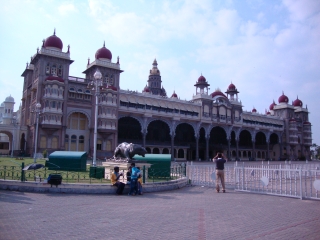
The Majestic Mysore Palace
A walk through this palace gives an impression of the wealth of the Vodeyars, the royal family that ruled the princely state of Mysore for over 400 years, until its dissolution into the Indian dominion. It also is natural for such a rich state to be formidable, because they could spend wealth on building strong armies. The Vodeyars spread their kingdom far and wide; and covered almost all of the present Karnataka state and beyond. While Mysore was a small kingdom within the mighty Vijayanagar Empire earlier, Raja Vodeyar spread it after the Vijayanagar disintegrated in the 16th Century. However, they could not hold on to this power forever and were defeated by Hyder Ali – father of the famous Tipu Sultan – in 1750 and he took over the Mysore. Tipu followed his father admirably well and ruled the Mysore Empire until his death in the 4th Anglo-Mysore war in 1799.
Hyder Ali, in total contrast to the Vodeyars, was the son of an army lieutenant. He showed great valor while fighting for the Mysore army, built his own corps and virtually dethroned the then Vodeyar king to de facto rule the grand Mysore Empire. He defeated the British Army in the 2nd Anglo-Mysore war and entered into a treaty with them to define the boundaries for his own kingdom. Tipu took over after his father’s death and ruled Mysore until 1799. Immediately after Tipu’s death, the Vodeyars signed a pact with the British and returned to rule Mysore, though only as figureheads for the British East India Company.
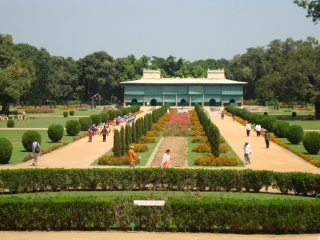
Tipu's Summer Palace in Mysore
This fascinating history of Mysore raises a question – who were truly the worthy rulers of Mysore? The Vodeyars, who had a long history, wealth and armor but lost to a contender whose strength was nowhere close; or the father-son duo of Hyder Ali and Tipu Sultan who built their power through sheer determination, defeated the mighty British army but ruled with a fist of iron? Perhaps the cavalier Vodeyars got laid-back and did not realize the Hyder breathing down their necks; and to return later as British agents to rule Mysore was unpardonable as well, but they were good and popular rulers. They were worshipped by the people as God’s descendants; and the Vodeyars although lost in their luxury and wealth cared for the people. Hyder and Tipu were both ambitious and perhaps are better known to the followers of history because of their determination and appetite for growth than the Vodeyars, but were ruthless. While Tipu built dams, roads and ports and took his trade to Sri Lanka, Iran and Turkey and spread the Mysore fame far and wide, his attitude towards the Hindu majority of his Empire has been greatly challenged. As a devout Islamic emperor, he was anything but an egalitarian while treating the Hindus. His image of a persecutor of Hindus, who either massacred them or converted them in masses would remain as a legacy.
While it is not an easy task to answer this question – and perhaps there is no one answer to this – the fact is that the history of the Mysore kingdom is extremely remarkable, with several ups and downs and offers a blend of riches, valor, brutality, and a newfound appreciation and respect for fine arts, culture and people’s representation in the rule. Very few realms in India can boast of such an assortment.
 The sound of thought